Select Your Location
Please select your location



Today’s knowledge-driven organizations face a fundamental spatial challenge: employees need both sustained deep focus and frequent cross-team collaboration; they must maintain physical and mental well-being while delivering high-performance outcomes. How can a single workspace effectively support these seemingly contradictory demands?
At its Shanghai office, VOLVO—the iconic Nordic brand built on principles of “safety” and “human-centricity”—has found a compelling answer.
As Volvo’s spatial solutions partner, NOVAH didn’t start by asking “What furniture should we place?” Instead, we began with real workplace behaviors and the company’s core culture. Through a systematic, human-centered design approach, we co-created a modern office environment that seamlessly supports individual well-being while actively fostering team connection—striking the delicate balance that defines the future of work.

In an office environment where automotive R&D, engineering, and marketing teams coexist, prolonged sitting is the norm. Yet the fatigue, waning focus, and chronic strain caused by static postures are quietly eroding productivity.
Volvo’s response is clear: embed health into everyday work—not rely on individual willpower. Across its Shanghai office, Dyna Pro height-adjustable desks, powered by the LINAK® intelligent lifting system, enable seamless transitions between sitting and standing. With whisper-quiet motors and rock-solid stability, the shift happens smoothly and unobtrusively—ensuring that “moving more” becomes a natural, integrated part of the workflow, not an afterthought.

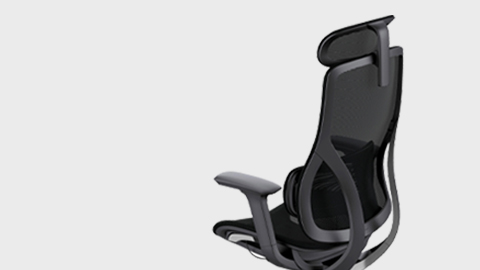
Complementing the setup is the AiX ergonomic chair, featuring a distinctive “X”-shaped structural support that precisely follows the natural curvature of the spine. Its dynamic, adaptive support significantly reduces lumbar strain and extends periods of focused, high-performance work.
Together, these design choices send a clear message: health is not a perk—it’s foundational infrastructure for productivity.


Volvo’s teams observed that over 60% of meaningful interactions don’t take place in formal meeting rooms, but rather in informal zones—by the coffee station, along corridors, or at stairwell landings: places where people can bump into each other, pause briefly, and speak openly without pressure.
In response, the office space was intentionally structured into multiple tiers of collaboration, each calibrated to a specific type of interaction and behavioral expectation—from quick huddles to focused co-working. This layered approach ensures that every spontaneous conversation and planned exchange finds its ideal setting, making collaboration not just possible, but purposeful.
For deep collaboration, such as technical reviews, private meeting rooms are equipped with the FourSure 11 conference chair. Its gravity-sensing casters glide effortlessly when users stand up, yet lock firmly into place upon sitting—ensuring both stability during intense discussions and smooth mobility when needed. Paired with the sleek, streamlined Cluster meeting table, this setup fosters a focused, high-efficiency environment ideal for critical decision-making.


For serendipitous exchanges—like spontaneous cross-departmental idea sharing—Signs high tables are strategically placed at key intersections of open areas and café-style lounges. These not only create subtle spatial zoning but also align with younger employees’ preference for informal interaction. The bar-height design naturally encourages standing “micro-meetings”: a quick coffee in hand, a five-minute sync, and alignment is achieved—without booking a room or disrupting workflow. In this way, meaningful connections emerge organically, woven into the rhythm of daily work.


This layered strategy ensures that collaboration happens on demand and at the right level of intensity, dramatically enhancing the organization’s information flow and decision velocity.


Volvo’s Nordic DNA is expressed not only through light wood tones and clean lines, but more profoundly through an extreme restraint toward distraction. There are no flashy decorations, complicated mechanisms, or jarring colors. Every piece of furniture features soft edges, warm materials, and intuitive functionality—because great design is felt, not noticed.
The Shanghai office thus delivers a systemic response to three core demands of modern work:
✅ Physical Sustainability: Reducing health strain through dynamic, movement-enabled workstations;
✅ Cognitive Sustainability: Protecting focus through purpose-built spatial zoning;
✅ Relational Sustainability: Accelerating knowledge exchange via thoughtfully placed informal touchpoints.
At its heart, this represents a paradigm shift—from “space decoration” to “behavioral infrastructure.”
At NOVAH, we believe that true workplace solutions aren’t about stacking products, but about deeply understanding how people actually work—and then designing environments where better behaviors happen effortlessly.
Moving forward, we will continue to start with behavioral insights and apply modularity, adaptability, and human-centered thinking to help more organizations build work ecosystems that genuinely serve people.


© 2024- NOVAH. All rights reserved.